Math activities for preschoolers: short, play-based sessions with printable cards
A how-to collection of short, play-based math activities parents and caregivers can run at home. Each activity uses common materials, quick demo outlines, caregiver prompts and simple next-step suggestions to build counting, sorting, patterns and measurement skills.
Decide what you want to practise this week—counting, sorting, patterns, or simple measuring—and plan short, playful sessions you can repeat. Aim for 5–15 minute activities that use real objects, lots of talk, and one clear goal per session. Repeat favorites across several days with small changes (different materials, different targets) so children meet the same skill in new contexts. With repeated play caregivers often notice children counting reliably to smaller numbers, sorting by a single feature, finishing simple AB patterns, and using words like “more/less,” “bigger/smaller,” or “next/last.”
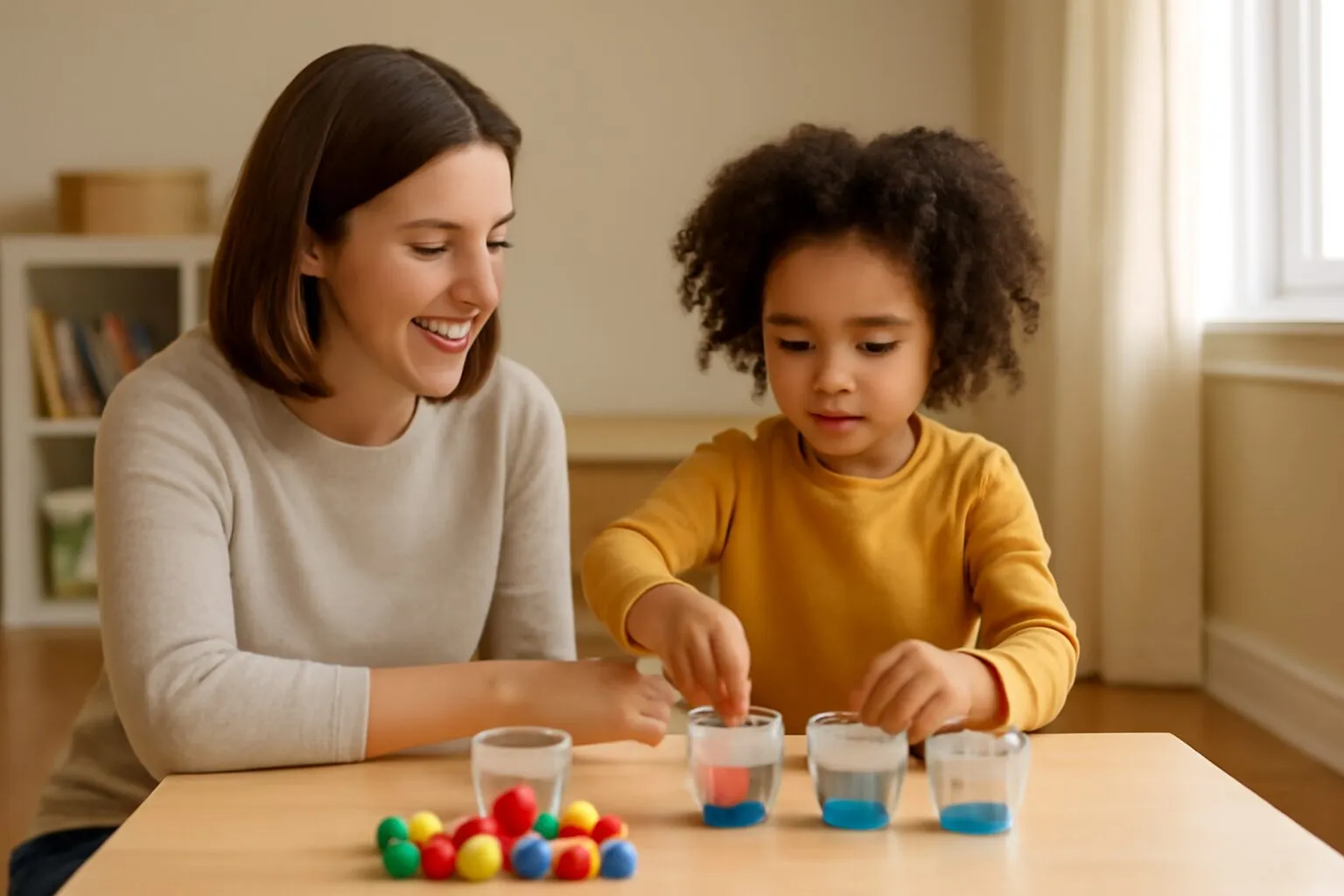
Before you start: quick decisions and a prep checklist
Decide how often you’ll play and which goals you’ll target. Keep sessions short, follow the child’s interest, and stop when attention fades.
- Gather simple materials from around the house (buttons, pom-poms, blocks, cups, dice).
- Plan 2–3 short activities per week and repeat favorites.
- Use clear, consistent language and ask open-ended questions (see scripts below).
- Keep a relaxed tone: follow the child’s interest and celebrate attempts rather than only correct answers.
Printable activity sheet template (make one page per game)
Decide what to record on a single sheet so you can prep fast: copy these fields into a document or notes app and print one page per activity.
- Activity name
- Materials (list)
- Setup (1–2 sentences)
- Child steps (numbered 1–5, simple sentences)
- Caregiver prompts (short phrases or questions)
- Learning goal (one sentence)
- Safety notes
Why these play-based activities work
Decide which early math goal you want to build: number sense, one-to-one correspondence, sorting and classification, patterning, or spatial reasoning. Short, hands-on sessions let children handle objects, hear repeated vocabulary, and test ideas immediately—advantages preschoolers need over formal lessons.
10 hands-on activities (materials, child steps, caregiver prompts and short demo outline)
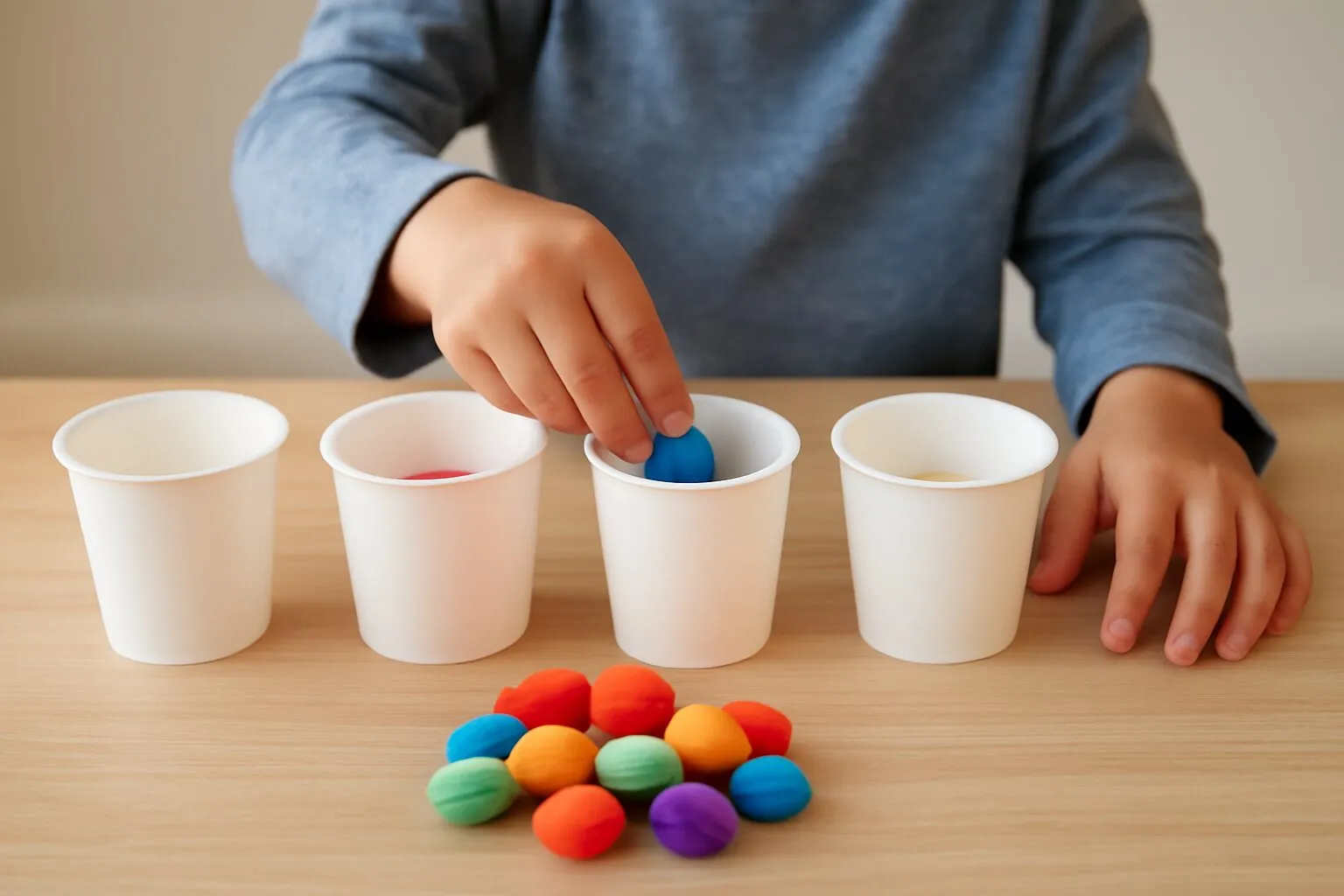
1. Pom-pom Counting Cups
What to do: Practice one-to-one counting by filling labeled cups.
Materials: small cups or bowls, pom-poms or counters, marker to label cups.
Setup: Label cups 1–5 (or 1–10) and put a pile of pom-poms in the center.
Child steps:
- Pick a cup and say the number on it.
- Put one pom-pom into the cup for each count word (one, two, three…).
- Stop when the cup has the same number as the label.
- Check by counting together if needed.
Caregiver prompts: “Which cup has the number three? Can we put three pom-poms here? Let’s count together — one, two, three.”
Learning goal: one-to-one correspondence and number recognition.
Short video demo outline (30–60s): Show labeled cups, place pom-poms one at a time while saying counting words, pause to show correct cup and count; end with child pride shot.
2. Nature Number Match
What to do: Use natural items to connect numerals to quantities.
Materials: paper number cards (1–10), small nature collection (leaves, sticks, stones).
Setup: Scatter number cards on a tray or blanket. Put nature items in a pile.
Child steps:
- Pick a number card.
- Find that many nature pieces and place them on the card.
- Say the number and point to each item as you count.
Caregiver prompts: “Show me the number four. How many sticks do we need? Can you point as you count?”
Learning goal: counting with natural materials and connecting numerals to quantity.
Video outline: Quick outdoors setup, child choosing a card, collecting items, counting into card with close-up on fingers and items.
3. Sort-and-Count Treasure Bins
What to do: Sort mixed objects and count each group to practise classification and comparison.
Materials: small tray/bin, mixed small objects (buttons, coins, beads), sorting bowls.
Setup: Fill a tray with mixed objects and place empty bowls labeled by color or shape.
Child steps:
- Pick one object from the tray.
- Decide which bowl it belongs in (color or shape).
- Place it in that bowl and count how many items are there.
Caregiver prompts: “Which bowl is for red buttons? How many red buttons do you have now? Do we have more red or blue?”
Learning goal: sorting, classifying and comparative language (more/less).
Video outline: Overhead shot of sorting action, caregiver asking comparison, child answers, show final counts in each bowl.
4. Pattern Necklace (AB and AAB)
What to do: Make a repeating pattern on a string to recognise and extend patterns.
Materials: large beads or cereal pieces, string or pipe cleaners.
Setup: Arrange two or three bead colors in a visible repeating example.
Child steps:
- Look at the example pattern (e.g., red, blue, red, blue).
- Choose beads and make the same repeating order on your string.
- Say the colors as you add them: “red, blue, red…”
Caregiver prompts: “What comes after red? Can you make the pattern go longer? What if we try AAB—two reds then a blue?”
Learning goal: recognizing and extending repeating patterns.
Video outline: Close-up of beads and string, child repeating pattern aloud with slow camera pan to finished necklace.
5. Shape Hunt and Sort
What to do: Find objects around a room, name their shapes, and sort them on plates.
Materials: paper plates labeled with shape names or drawn shapes (circle, square, triangle), small toys or printed pictures.
Setup: Hide picture cards or small objects around a room representing different shapes.
Child steps:
- Find an object and name its shape (or say the feature: round/pointy).
- Put it on the matching shape plate.
- Count how many of each shape appear when done.
Caregiver prompts: “Is that shape round or pointy? Which plate does it belong on? How many circles did we find?”
Learning goal: shape recognition and sorting by attributes.
Video outline: Child discovery clips, naming shapes, placing on plates, final counts shown.
6. Balance Scale Compare
What to do: Use a simple scale to compare weight and practise comparative words.
Materials: simple balance scale, assorted small toys or blocks.
Setup: Put a few objects on a tray next to the scale.
Child steps:
- Place one object on one side and another object on the other.
- Observe which side goes down or if they balance.
- Use words: heavier, lighter, same.
Caregiver prompts: “Which is heavier? How can we make them balance? What would happen if we add one more block?”
Learning goal: comparing weight and using comparative vocabulary.
Video outline: Side view of scale movement, child labeling heavier/lighter, simple experiment adding items to balance.
7. Ten-frame Race
What to do: Fill a ten-frame by rolling a die to practise composing numbers and counting on.
Materials: printed ten-frame (or draw 2×5 grid), counters, dice or spinner.
Setup: Give each child a ten-frame and counters in a color; have a die.
Child steps:
- Roll the die.
- Place that many counters on your ten-frame (one at a time while counting).
- Take turns until someone fills their ten-frame or reaches a target.
Caregiver prompts: “How many did you roll? Can you show me by placing them one by one? How many more until your frame is full?”
Learning goal: subitizing support, counting on, and composing numbers up to ten.
Video outline: Fast cuts of rolls and placing counters, highlight counting sequence, finish with completed ten-frame.
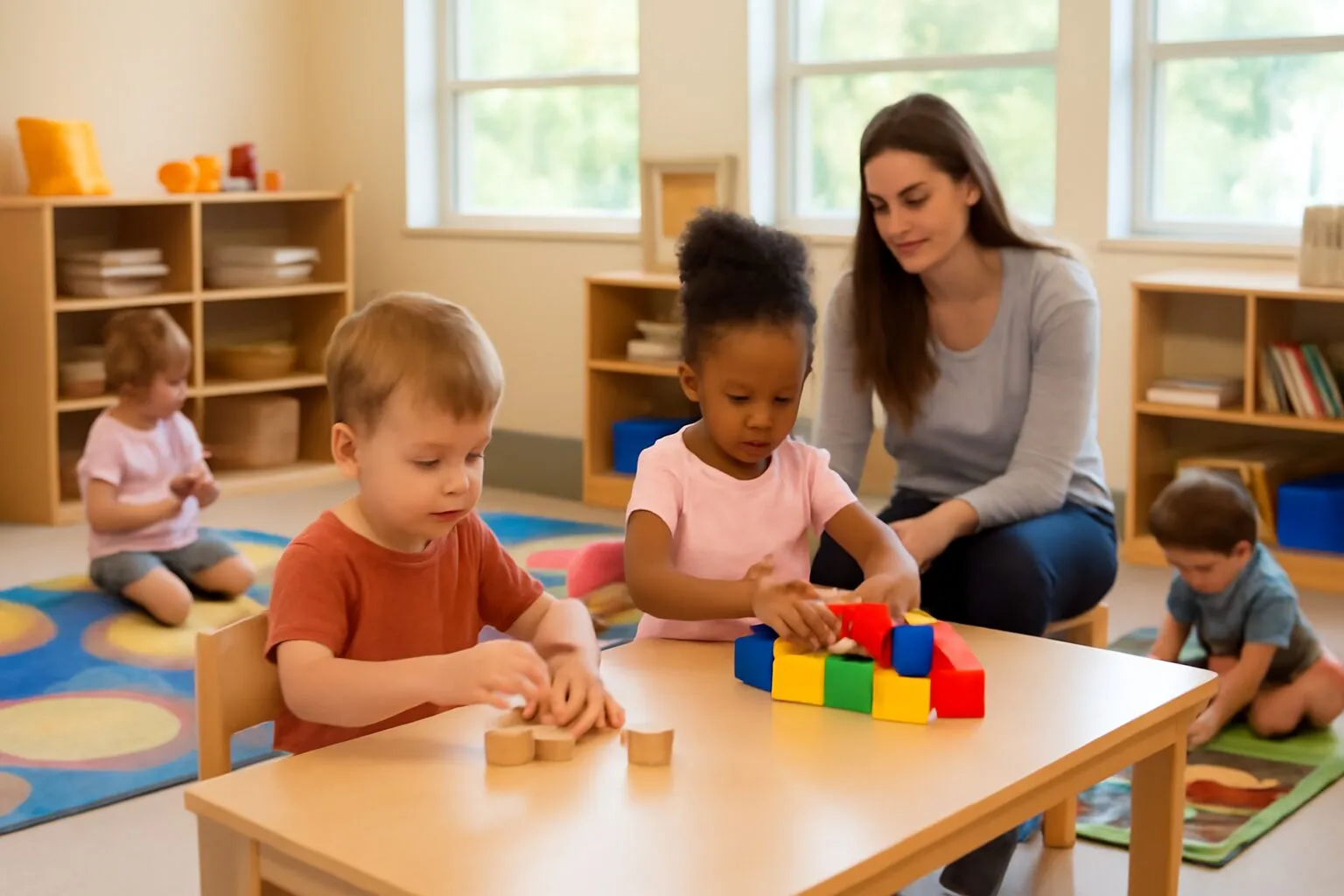
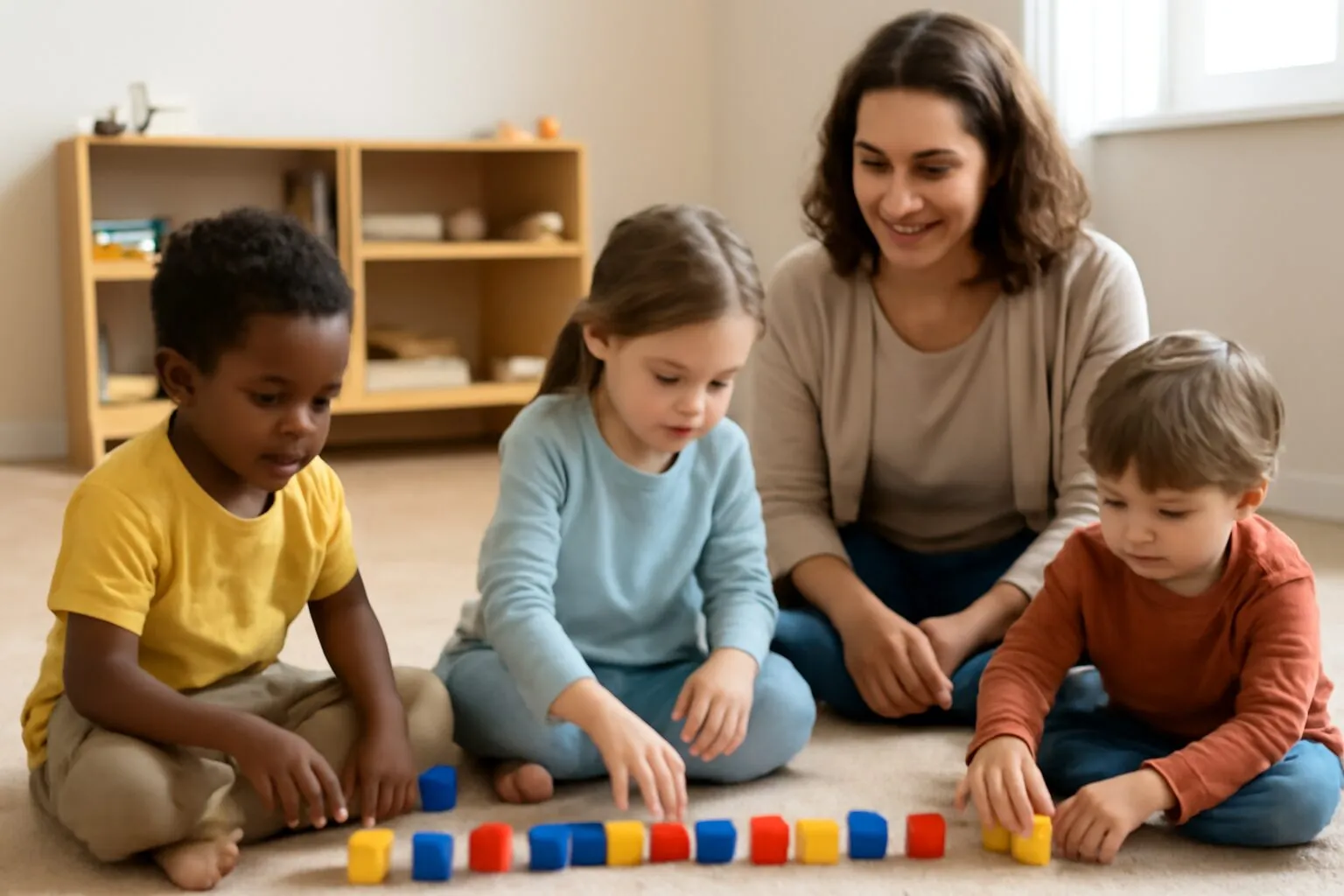
8. Measuring with Blocks (Nonstandard Units)
What to do: Measure toys using blocks to introduce the idea of units and comparison.
Materials: uniform blocks or cubes, a small toy or book to measure.
Setup: Line up blocks and a toy to measure beside them.
Child steps:
- Place blocks end to end next to the toy from one end to the other.
- Count how many blocks long the toy is.
- Compare with another toy to say which is longer or shorter.
Caregiver prompts: “How many blocks long is the cup? Which is longer—the book or the cup? Can you show me by lining them up?”
Learning goal: measurement concepts using nonstandard units and comparative language.
Video outline: Overhead of blocks being lined up, counting aloud, side-by-side comparison of two toys.
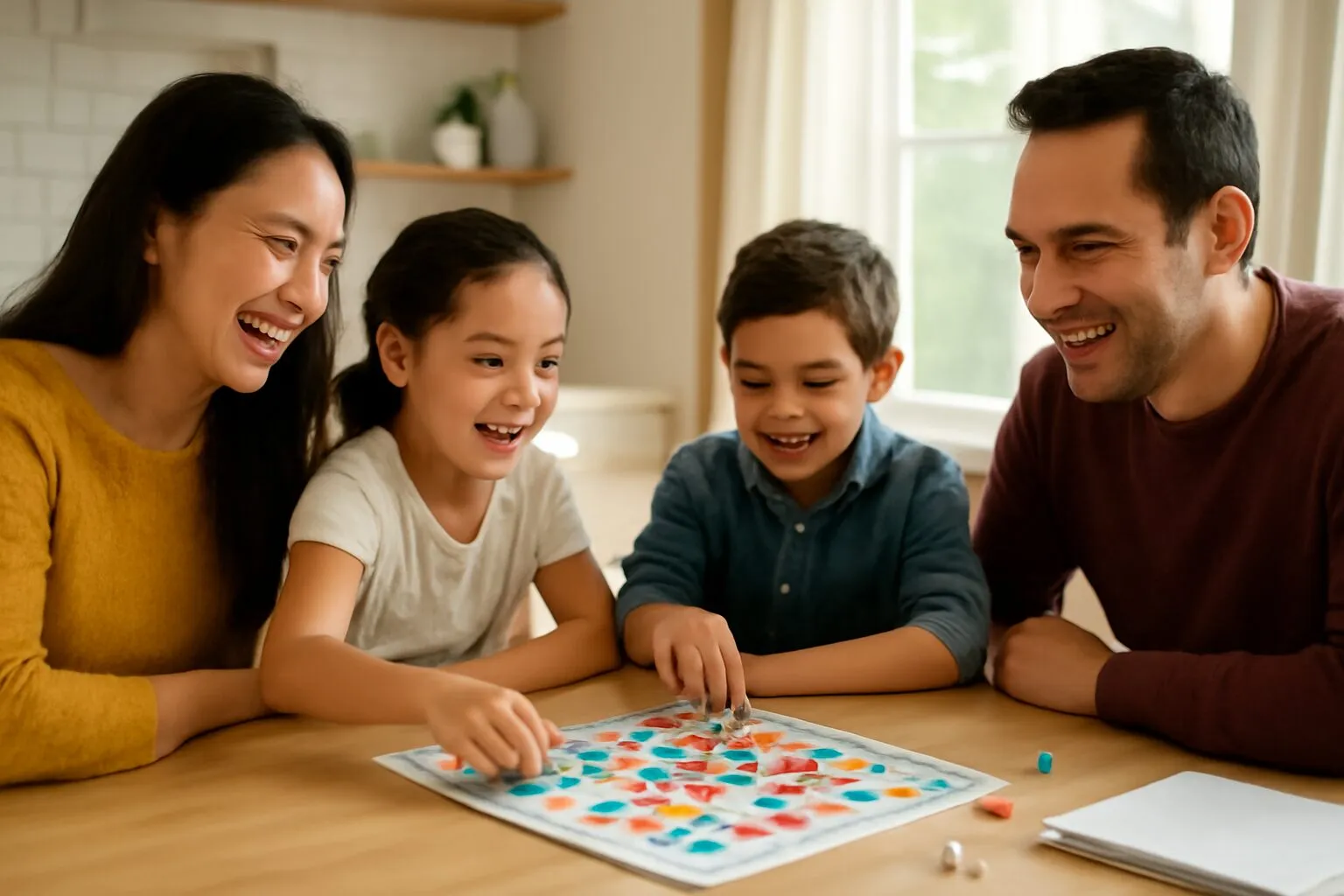
9. Roll-and-Color Number Board
What to do: Roll, identify a numeral, and colour—good for numeral recognition and turn-taking.
Materials: printable board with numbers (1–10), crayons or markers, one die.
Setup: Give the child the board and a die.
Child steps:
- Roll the die.
- Find that number on the board and color one section.
- Keep rolling until the board is filled or a target is reached.
Caregiver prompts: “What did you roll? Can you find number five on your board? How many squares have you colored?”
Learning goal: numeral recognition, counting, and turn-taking if played with others.
Video outline: Screen of board, child rolling and coloring, close-up of number identification, final colorful board shot.
10. Story Sequencing with Number Words
What to do: Put picture cards in order and label steps with number words to build sequencing and ordinal language.
Materials: 3–4 picture cards showing a simple sequence (planting seed, watering, sprout), number cards labeled 1–4.
Setup: Shuffle picture cards face up and give number cards.
Child steps:
- Look at the pictures and decide the correct order.
- Place number cards 1–4 under the pictures in the order they happen.
- Tell the story using first, next, then and last.
Caregiver prompts: “Which picture shows what happens first? What comes next? Can you tell the story using number words?”
Learning goal: sequencing, ordinal words (first/next/last), and linking number order to events.
Video outline: Show shuffled cards, child arranging with numbers, child telling sequence in short sentences.
Caregiver language and prompts: choose short phrases to use often
Decide which phrase set matches the activity and repeat them—keep comments two to six words or short questions.
Counting and one-to-one correspondence
- “Let’s count together: 1, 2, 3…”
- “Can you put one pom-pom on each cup?”
- “Point to each toy as you count.”
Comparing and measuring
- “Which group has more?”
- “Is this taller or shorter?”
- “How many blocks long is the book?”
Pattern and classification vocabulary
- “What comes next in the pattern?”
- “Show me a red, then a blue, then a red—what’s next?”
- “Can you sort by color? By shape?”
Open-ended questions to encourage thinking
- “How could we check that?”
- “What else could we try?”
- “Why do you think that happened?”
Progression by skill and suggested pacing
Decide a general next step based on age and observed ability; use the guidance below as a loose scaffold not a timetable.
- Early preschool (about 2–3 years): focus on naming numbers, simple one-to-one (1–3 objects), and basic sorting by color.
- Mid preschool (about 3–4 years): increase counting to 5–10, AB patterns, use ten-frame for small groups, and compare two groups (more/less).
- Later preschool (about 4–5 years): practice counting on, simple composing (make 5 from 2+3), nonstandard measurement, and ordering 3–4 step sequences.
Adjust timing per child: some children progress faster; others need repeated exposure over weeks. The point is repeated playful practice rather than pushing mastery on a schedule.
Safety and supervision
Decide what to supervise closely. Many activities use small objects (beads, buttons, pom-poms). Supervise closely and keep choking-risk items away from children under age three, following your local safety guidance for small parts. Use large beads or puffed cereal for younger preschoolers and swap to smaller manipulatives only when you can supervise closely.
How to make a short demo video caregivers can copy
Decide on a clear 30–90 second structure: show materials, show setup, film one or two child steps (close-up on hands), include a caregiver prompt line, and end with the child finishing and a short line about the learning goal.
Troubleshooting common challenges
- If attention drops after 3–5 minutes, pause the activity and resume another time.
- If a child seems frustrated, reduce the number target (e.g., count to 3 instead of 10) and celebrate partial success.
- When a child repeats an error, model the step slowly and invite them to try again rather than correcting quickly.
Simple weekly plan to try
Decide two activities to test this week. Repeat each activity three times across several days with small changes (different materials, different target numbers). Track progress by noting one observable change (for example: child counted to five without help or produced an AB pattern independently).
Frequently asked questions
How often should we do these activities?
Short daily or every-other-day practice (5–15 minutes) helps more than a single long session each week.
Do I need printables or can I improvise?
Printables help consistency but most activities work with improvised household materials; the learning comes from talk and repetition.
Final note
Decide to keep play joyful and language-rich. When caregivers pair concrete objects, short talk, and repeated, playful opportunities, preschoolers build the early number sense that supports formal math later on.